


How to Choose the One Side Business Idea That Actually Fits Your Life
You've been adding ideas to your list for months. Maybe years. And every time you sit down to actually pick one, you freeze. Here's the four-filter framework that finally got me unstuck, and the one I use every single time before committing real time and energy to a new idea.
Or maybe it's the opposite for you. You stare at the blank page and think "I don't even know what I'd sell."
Here's what I've come to understand after years of doing both myself. The woman with twenty ideas and the woman with none are stuck in exactly the same place. And they both need the same thing.
Not more ideas. Not fewer. A filter.
Why Picking a Business Idea Is So Hard (And What Most Women Get Wrong)
I once built an entire Shopify store around accessories for yarn lovers. Cute idea. Lovely products. The only problem? I don't knit. I've never knitted. My mum and my aunt knit, which is what inspired the whole thing, and it felt exciting in the moment.
But there was no real connection between me and that idea. And it showed.
I spent months on it. I made almost no money. And I quietly let it die.
That experience taught me something I now use every time before committing to a new idea: excitement isn't enough. Neither is "this seems like a smart market." You need an actual way to evaluate whether an idea is worth your time and energy. That's what the Four-Filter Framework is for. It takes the idea you're most drawn to right now and runs it through four honest questions, so you can stop spinning and start moving.
Filter 1: Skills
The first question is simple: do you already have a skill that could underpin this idea, or would you have to learn everything from scratch?
You don't need to be an expert. You just need to be one step ahead of the person you're helping. But there's a really big difference between building on something you know and starting from zero. Existing skills give you a head start, credibility, and something real to say, which makes creating content and talking to customers so much easier.
And here's where most women trip up. We consistently undervalue what we already know. If you've spent twenty years in HR, you understand people, communication, and conflict resolution at a depth most people never reach. If you've raised kids, you've mastered time management, negotiation, and patience in ways no business school teaches. If you've managed a household budget through hard times, you've got real financial skills.
Write down every skill you have, big or small. Then look at your idea list and ask: which of these could I build on something I already know?

Filter 2: Time
This is the filter most people skip in the excitement of a new idea, and then wonder why everything falls apart three weeks in.
The question is: does this idea fit the time I actually have, not the time I wish I had, but the real, honest time I have today?
Most of us aren't going to suddenly find ten extra hours a week. We've got jobs, families, and the low-grade exhaustion that comes from being a midlife woman holding a lot at once. So the idea you choose has to work inside your actual life, not a fantasy version of it.
This is actually really good news. It rules out ideas that need more bandwidth than you have, and it points you toward ones that can realistically be built in a few hours a week. A digital product. A simple service. A small community. These can all start in stolen pockets of time. That's not a limitation. That's a filter protecting you from setting yourself up to fail.
Ask yourself honestly: if I had five hours a week, could I make real progress on this?

Filter 3: Energy
This one is my personal favorite, because nobody talks about it and it makes all the difference to whether you'll actually stick with something.
The question: does this idea light you up enough that you'd keep going on the hard days?
Because the hard days come. For every business. Every single one. If the only thing pulling you toward your idea is the potential money or the fact that the market looks promising, that's not going to be enough when you're three months in, you haven't made a sale yet, and you're wondering why you're doing this.
"Enthusiasm gets you started. Genuine interest is what keeps you going."
James Clear, author of Atomic Habits, says the most reliable predictor of long-term success isn't talent or strategy. It's showing up consistently. And you can only show up consistently for something that genuinely holds your interest.
Look at your idea and ask: could I talk about this for a year without getting bored? Could I write emails about it, record videos about it, answer questions about it, even when it's slow?
Filter 4: Momentum
The final filter asks: is there a clear first step, and can this idea start generating results, even small ones, relatively quickly?
I want to be careful here, because I'm not saying you need to make a thousand dollars in your first week. That's not how most businesses work. But your idea should have a clear path to a first result. Your first subscriber. Your first sale. Your first DM from someone saying "this helped me." Something that tells you you're moving in the right direction.
This filter also asks about demand. Not theoretical demand, but real evidence that people actually want what you're offering. You don't need a huge research project. Just look around. Are other people successfully selling something similar? Are there Facebook groups or Reddit threads where people are asking for help with this exact thing? If yes, there's demand. And that's good news, because you're not trying to create a market from scratch. You're finding your place in one that already exists.
I walked through every filter in detail in Episode 28 of The Bold Biz Podcast. If you'd rather listen than read, find it right HERE

How to Read Your Results
Once you've run your idea through all four filters, here's how to interpret what you get:
Passes all four. You've got something worth building. The next step is to start. Imperfectly. Right now. With what you've got.
Passes two or three. Useful information. The filter it fails on might be something you can work around. Maybe the timing is off this year but right next year. Maybe you don't have the skill yet but could learn it in three months.
Fails most of them. This is actually the best possible thing to find out now. Before you've spent six months and a few hundred dollars building something that wasn't right for your life in the first place.
The framework is a diagnostic, not a pass/fail test. It's designed to give you clarity, not to talk you out of things.
I genuinely wish someone had handed me this four years ago. It would have saved me at least two Shopify stores and one very expensive life coaching certification.
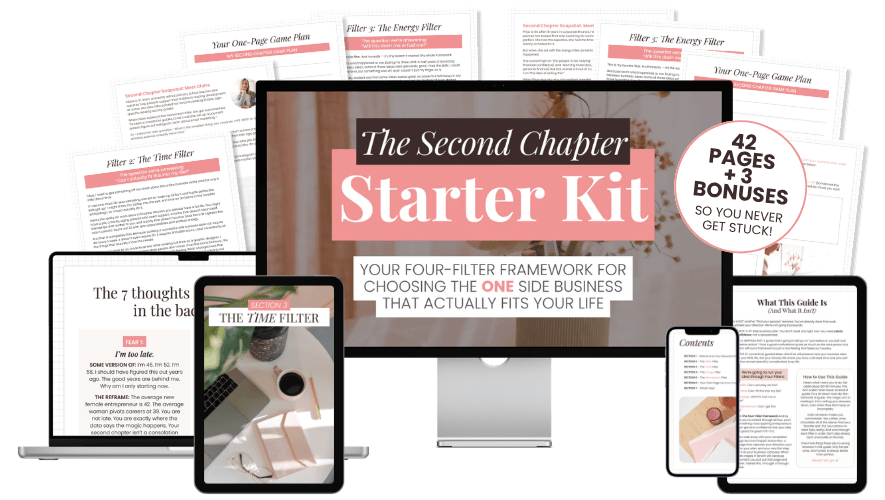
If you want to actually run your idea through the framework with real prompts and exercises, instead of just thinking about it in your head, I built something for exactly that. The Second Chapter Starter Kit is a $27 guided workbook that walks you through every filter step by step, and it ends with a One-Page Second Chapter Game Plan so you finish with a real direction, not more thinking to do.
Grab it HERE.
You've got this. ✨
Stay bold ladies!
/Jenny xo

This post is based on Episode 28 of The Bold Biz Podcast. Listen to the full episode on Apple Podcasts, Spotify, or wherever you get your podcasts.
Let us know what you think in the comments!
Newsletter
Subscribe to the newsletter and stay in the loop! By joining, you acknowledge that you'll receive our newsletter and can opt-out anytime hassle-free.
Created with ©systeme.io