


Why Your Side Business Progress Isn't Linear (And What to Do When You're in the Valley)
Can I tell you about a Tuesday evening I had a while back? I had just sat down to work on my business after a full day at my 9 to 5. I opened my laptop, looked at my follower count, looked at my email list, looked at my revenue, and I thought: what is the point. I've been doing this for months. Nothing is moving. Maybe I'm just not cut out for this.
I closed the laptop. I made tea. And I sat there feeling like a complete failure.
What I didn't know in that moment, what nobody had told me, was that I was about to turn a corner. That the valley I was sitting in had an exit. And that what I was experiencing wasn't evidence that I was failing. It was just what the timeline actually looks like.
If you're in that valley right now, this post is for you.

The Myth of the Straight Line
One of the most damaging ideas in online business is that progress should be linear. That if you show up consistently, the results should climb in a smooth, predictable upward line. More effort equals more results. More time equals more growth. And if the line ever flattens or dips, something must be wrong.
That is not how it works. It's genuinely not.
James Clear, author of Atomic Habits, talks about what he calls the plateau of latent potential. When you start building something new, you don't see results immediately. You put in the work and nothing seems to happen. And then nothing. And then nothing. And then, seemingly out of nowhere, things start to move.
Not because the work suddenly kicked in. But because it was always working, underneath the surface, building the foundations that your eventual results will stand on. You just couldn't see it yet.
He uses the image of an ice cube in a frozen room. You turn up the heat. Still frozen at 25 degrees. Still frozen at 28, 29. And then at 32 degrees, it melts. Was all that warming doing nothing? Absolutely not. It was everything. The evidence just shows up at the breakthrough, not during all the work that made it possible.
That is exactly what building a side business feels like. And I wish someone had drawn that picture for me at the beginning.
What the Valley Actually Feels Like
Let's name it, because when we're in the valley we often assume we're the only one who feels this way. We're not.
The valley is when you've been posting consistently for two months and your follower count has barely moved. It's when you send an email and three people open it, and one of them is probably you checking if it sent. It's when you launch something and nobody buys. It's when you spend an entire Sunday building and then on Monday it all feels completely pointless.
It's also quieter than that sometimes. A low hum of doubt. A voice that says, who do you think you are. A tiredness that isn't really about sleep. A creeping feeling that maybe you're not one of the people who gets to do this.
I've felt all of those things. Many times. And the women I most admire in this space, every single one of them has felt those things too. It's not a sign you're in the wrong place. It's a sign you're building something that matters enough to scare you. Those two things tend to go together.
Why Women Over 40 Feel It Harder
By the time we're in our 40s and 50s, we have decades of competence behind us. We know how to do things. We're good at our jobs. We've earned a certain quiet confidence in our own abilities.
And then we start a side business and we're back at zero. Zero followers. Zero email list. Zero proof that anyone is interested in what we have to say.
That contrast, between who we are in the rest of our lives and who we are in this new thing we're building, can feel genuinely humiliating. Not dramatically. Just in a quiet, grinding way that makes it very tempting to stop.
There's also the time pressure. We're often building alongside full-time jobs, families, aging parents, busy households, and an energy level that, let's be honest, isn't always what it was at 28. So when we invest our limited precious hours and don't see results fast enough, the cost of continuing feels higher.
And then there's comparison. Social media shows everyone else's highlight reel at the exact moment you're sitting in your own valley. You see the launch results, the follower milestones, the passive income screenshots. You don't see the 18 months of invisible work that came before.
But those months happened. For every single one of them.
The Seasons of a Side Business
I find it helpful to think about a side business the way you'd think about seasons. We don't stand in February and think, this winter is going on too long, maybe spring just isn't coming this year. We trust the process because we've seen it enough times to know how it works.
A side business has seasons too.
The Planting Season
This is the very beginning. You're setting up foundations, figuring out your offer, creating your first lead magnet, telling a few people what you're doing. Nothing feels like it's working because you haven't planted enough yet. This isn't failure. This is just February.
The Growing Season
You're posting consistently, building your list slowly, maybe making your first small sale. Progress feels invisible because growth that's happening underground is invisible. The roots are going down. The stem is reaching up. You can't see it yet. But it's happening. This isn't failure either. This is March and April. Trust it.
The Harvest Season
This is when things start to compound. When the consistency you built in the invisible months pays off in visible ways. New followers who found you through old content. Email subscribers who've been quietly reading for months and suddenly buy. A post that lands and spreads. A DM from someone who says you changed how I think about this.
The harvest doesn't come without the planting and the growing. But it does come.
Brene Brown talks about how we measure ourselves against other people's highlight reels, their harvest seasons, and then wonder why we feel inadequate in our own growing season. That comparison isn't just unfair. It's comparing the wrong things entirely.
The Small Wins We Keep Walking Past
Here's something genuinely underestimated: the art of celebrating small wins. Not in a forced, gold-star kind of way. But in a real, intentional, I'm going to notice this and let it count kind of way.
Our brains are wired to focus on what's not done yet, what's not working yet, what's still missing. It's a survival mechanism that was useful when we were trying not to get eaten by things. It's not useful when we're trying to build a business and stay motivated through the slow parts.
So here's what counts as a win, even when it doesn't feel like one:
Your first email subscriber who isn't your mum or your best friend
Your first piece of content that gets saved by someone you don't know
Finishing your lead magnet after weeks of putting it off
Publishing your first piece of content when every cell in your body said wait until it's better
Getting a DM from someone saying, I really needed to read this today
Amy Porterfield, who has built one of the most successful online education businesses in the world, talks about keeping a win file. A literal document where she writes down every positive thing that happens, no matter how small. And she goes back to it on the hard days. Not to feel smug. But to remind herself that progress is actually happening, even when it doesn't feel that way.
I've started doing this too. And it has genuinely changed how I experience the slow periods.
When to Push Through and When to Pivot
This is where a lot of women get stuck: the uncomfortable middle ground between persistence and flexibility.
Here's how I think about it. There's a difference between quitting because something is hard and quitting because something genuinely isn't working. The first one is worth pushing through. The second is worth investigating.
If you've been building for less than six months and haven't seen the results you hoped for, that's almost certainly not enough data to make a meaningful judgment. You haven't hit 32 degrees yet.
But if you've been doing the same thing for 12 months or more and nothing has moved even slightly, it might be worth asking not whether to quit, but whether something in the approach needs adjusting. The niche, the messaging, the platform, the offer.
The key question to ask yourself in the valley: am I not seeing results because I haven't given it enough time, or am I not seeing results because I'm not talking to the right people in the right way about the right thing? The first calls for patience. The second calls for a small experiment. Both are valid. Neither means you're failing.
Seth Godin has a concept called the dip, the idea that every worthy endeavour has a period in the middle where it gets hard and progress slows. Most people quit during the dip because they interpret it as a signal they chose wrong. But the dip is actually a feature, not a bug. It's what filters out the people who aren't serious. The fact that it's hard is what makes getting through it worth something.
What I Know Now That I Wish I'd Known Earlier
A few things I genuinely wish someone had told me when I was in the thick of my own valley:
Slow is not the same as stopped. Every piece of content you create, every email you send, every skill you develop, it's all accumulating. Even when you can't see it. Especially when you can't see it.
Your timeline is yours, not hers, not theirs. The woman who grew from zero to 10,000 followers in six months might have been building in a different niche, with a different budget, with a team behind her, or with a previous audience she's never mentioned. You don't know her full story.
The valley is not permanent. Every woman I know who has built something real has been in the valley. Most of them more than once. And every single one came out the other side. Not because they had some special quality you don't have. But because they stayed.
And the fact that you're still here, still trying, still showing up for your idea even on the tired days and slow weeks, that is not nothing. That is actually everything.
Your Next Step: Start a Win File This Week
Here's something concrete to take away from this post.
Start a win file. A note on your phone is completely fine. Go back as far as you can and write down every win, big or small, that you've had in your business so far. Your first piece of content. Your first subscriber. Your first sale if you've had one. The DM that made you smile. The day you did the scary thing.
Then add to it every single week. One win, minimum. Because what you pay attention to grows. And if you start paying attention to the evidence that it's working, even slowly, even imperfectly, even just a little bit, you'll find more of it. And it'll be easier to stay in the game long enough to see what this really becomes.
Ready to Go Deeper?
If you're still searching for the right idea to start with, or you keep stopping and restarting and aren't sure why, I have two free guides that might be exactly what you need right now.
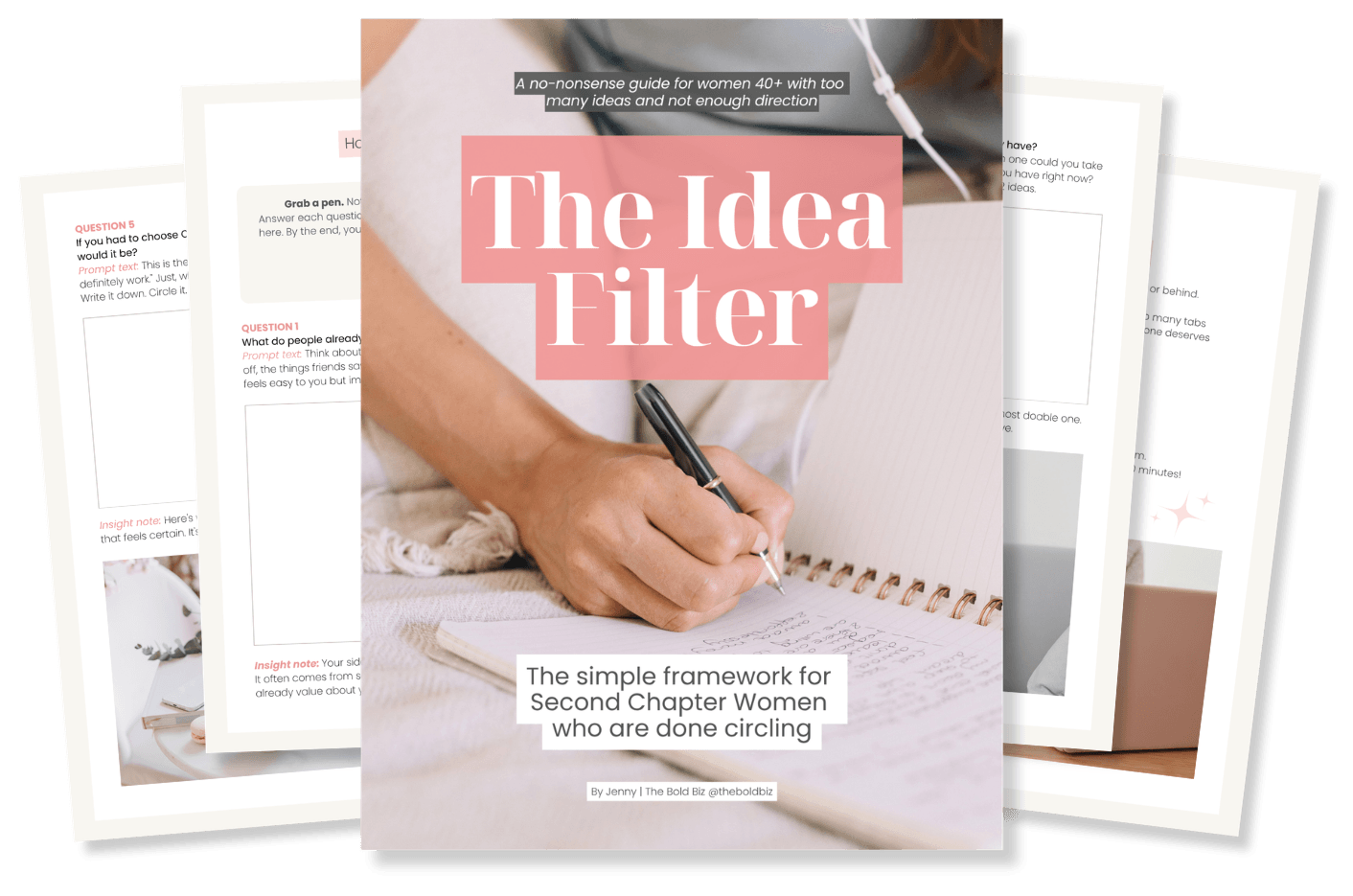
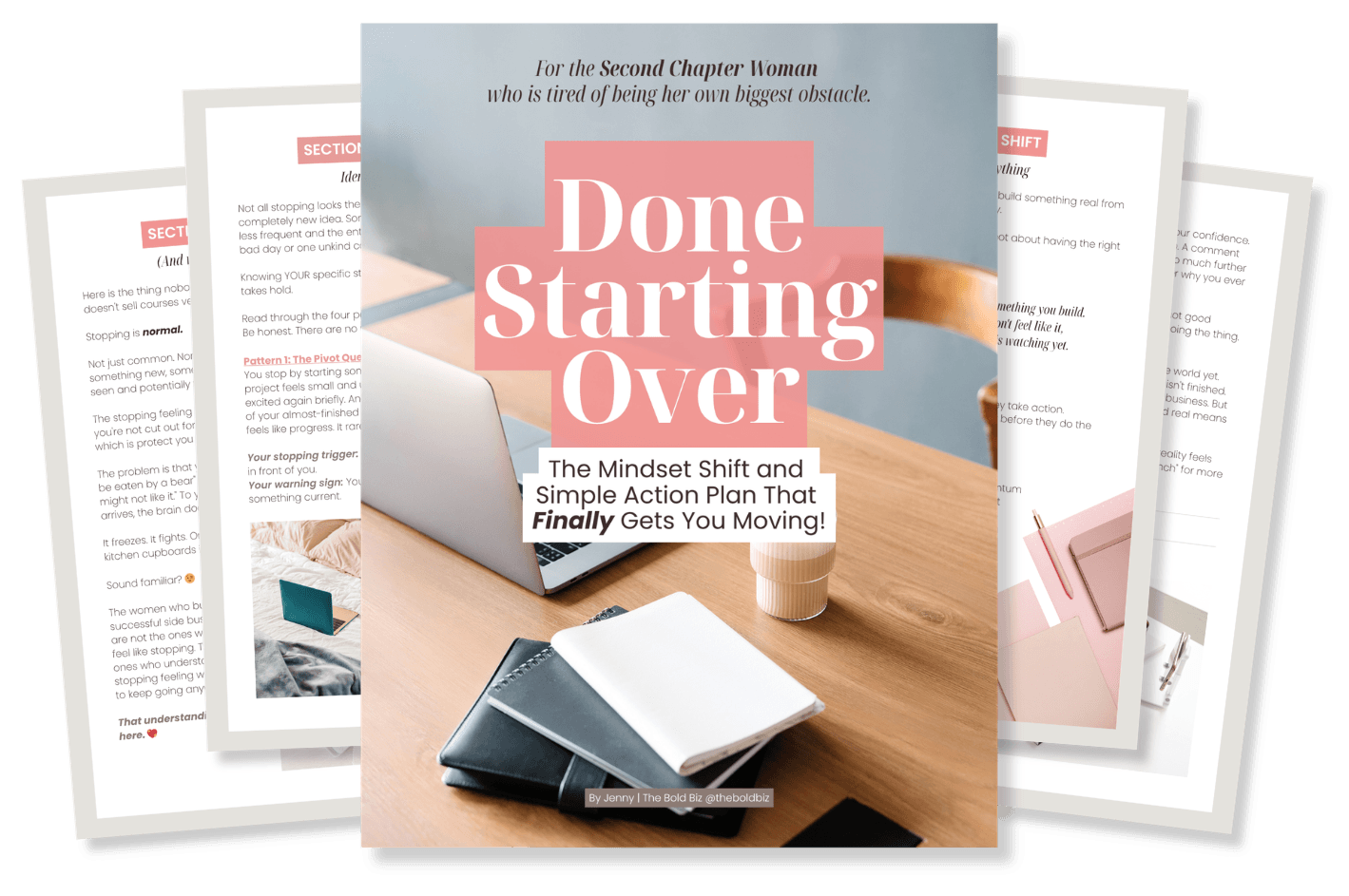
The Idea Filter helps you cut through the noise and land on the right idea for your life and your skills. Done Starting Over is for the women who have started and stopped before and want to finally understand the psychology of why that keeps happening, and how to break the cycle for good.
Both are completely free! Links below.

This post is based on Episode 25 of The Bold Biz Podcast. Listen to the full episode on Apple Podcasts, Spotify, or wherever you get your podcasts.
Stay Bold Ladies! 💫
Let us know what you think in the comments!
Newsletter
Subscribe to the newsletter and stay in the loop! By joining, you acknowledge that you'll receive our newsletter and can opt-out anytime hassle-free.
Created with ©systeme.io